
The future of organic agriculture in Uzbekistan is shaped not only by national strategies and regulatory frameworks.
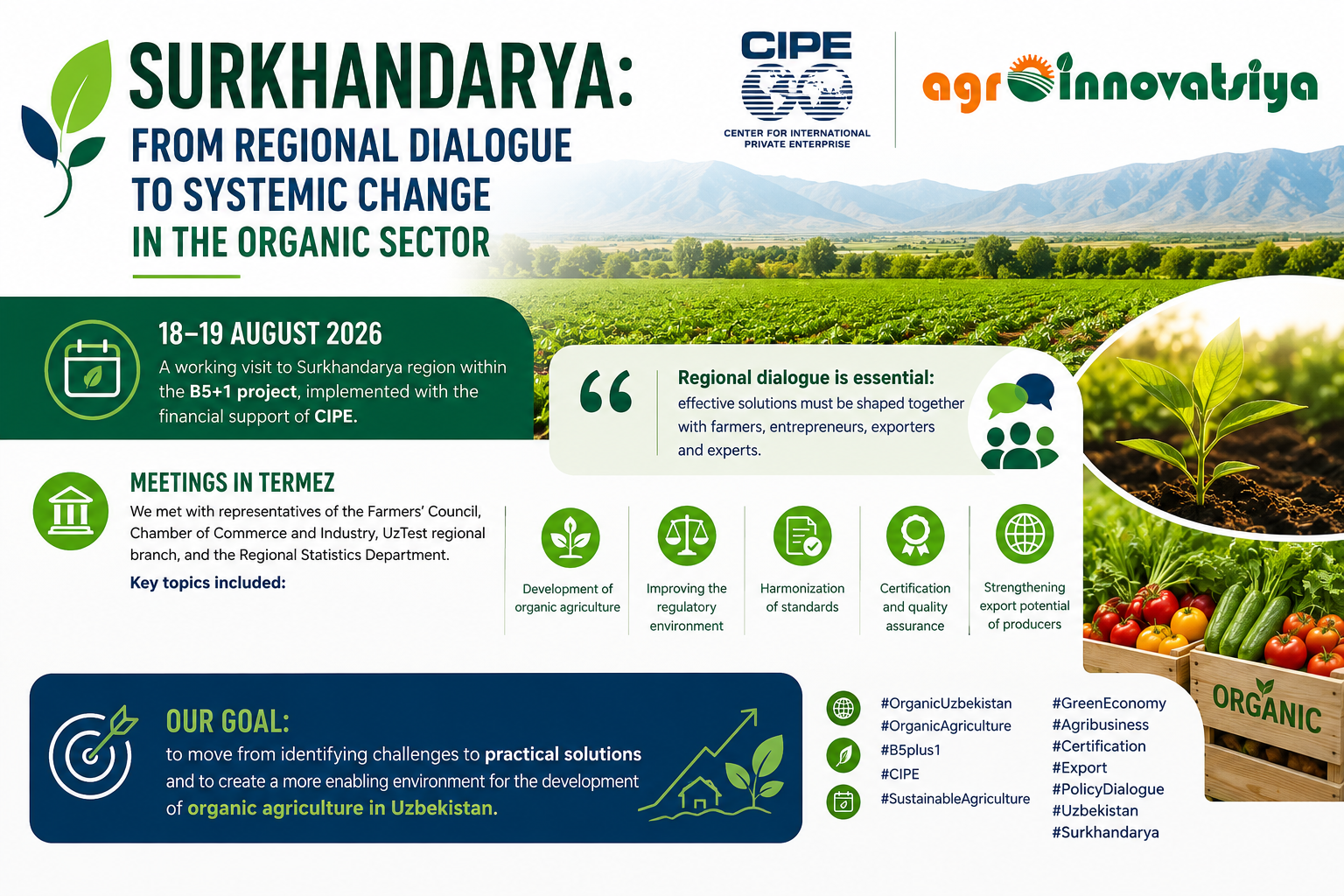
It is also being built in the regions through direct dialogue with farmers, entrepreneurs, exporters, certification bodies, statistical services, and other stakeholders in the agricultural sector. With this objective in mind, on 18–19 August 2026, K.K. Adilov, Project Manager, undertook a working visit to the Surkhandarya Region as part of the project “Strengthening Regional Policy Dialogue and Improving the Regulatory Environment for the Development of the Organic Sector under the B5+1 Initiative,” implemented with financial support from the Center for International Private Enterprise (CIPE). The main objective of the visit was to establish direct engagement with regional stakeholders for further research and expert consultations.
During the visit to Termez, working meetings were held with representatives of the Surkhandarya Regional Farmers’ Council, the regional branch of the Chamber of Commerce and Industry, the Surkhandarya branch of UzTest, and the Surkhandarya Regional Department of Statistics. What was discussed?
The discussions focused on key issues that directly affect the competitiveness of Uzbekistan’s organic products:
- the development of organic agriculture;
- improvement of the legal and regulatory environment;
-harmonisation of national standards with international requirements;
- strengthening certification and conformity assessment systems;
- improving the analytical and statistical base;
- identifying the real challenges and needs of farmers, processors, and agribusinesses;
- creating conditions for expanding production and enabling organic products to access new markets.
Special attention was also given to the participation of farming enterprises in the research, the distribution of survey questionnaires, expert consultations, and stronger engagement with agricultural exporters and processors. Another important area of discussion was access to reliable statistical information. Without high-quality data, it is impossible to objectively assess the state of the sector, identify administrative and institutional barriers, or develop effective recommendations for the future development of organic agriculture. Why does regional dialogue matter? Each region has its own agricultural characteristics, production potential, and institutional challenges. Effective public policy, therefore, cannot be developed exclusively through a top-down approach. It must also be informed by the voices of producers themselves. It is essential to listen to farmers, understand the challenges faced by exporters, take into account the perspectives of certification and testing organisations, analyse the needs of businesses, and align these perspectives with international requirements.
This approach makes it possible to move:
- from discussing problems → to gathering evidence;
- from isolated initiatives → to systemic cooperation;
- from general recommendations → to practical solutions. As a result of the working visit, cooperation with key regional organisations was strengthened, the project’s stakeholder network was expanded, and the foundation was laid for further surveys, expert interviews, and the collection of analytical information. The next stage is to translate the findings of the regional dialogue and research into practical recommendations for improving public policy, reducing administrative and institutional barriers, and creating a more enabling regulatory environment for the development of organic agriculture in Uzbekistan. The Surkhandarya Region has become another important point on the map of the emerging national dialogue on the future of Uzbekistan’s organic sector. And this dialogue continues.
#OrganicUzbekistan #OrganicAgriculture #B5plus1 #CIPE #Agriculture #SustainableAgriculture #GreenEconomy #OrganicSector #Agribusiness #Farmers #Certification #Export #RegulatoryReform #PolicyDialogue #SustainableDevelopment #Uzbekistan #Surkhandarya #Termez #Agroinnovatsiya